PAINTING PROJECT
Iteration 32,873 is a work that comments on the relationship between audience, artwork and technology. In particular, it explores the often-unconscious technological constraints that shape our perception of objects after they’ve been adapted to modern digital technology.
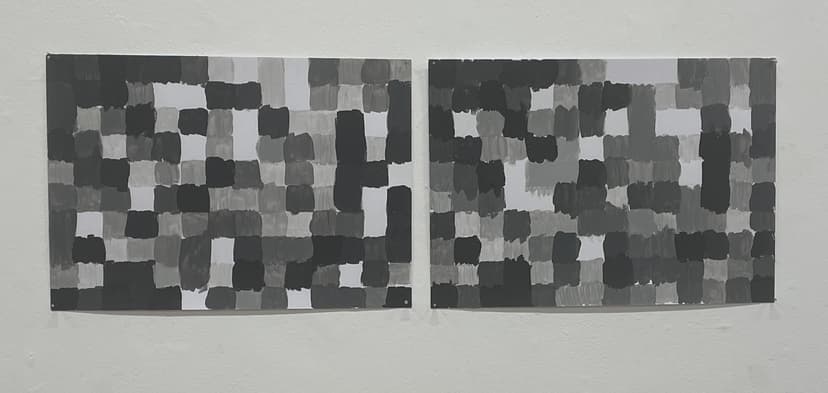
The work is a physical representation of a computer-generated grid of 10 by 14 pixels with assigned integer values between 0 and 1. These values represent a scale of uniform steps going from black (0) to white (1). This particular grid, in fact, is one of 100,000 iterations. Iteration 32,873 was selected as it displayed the maximum average absolute difference between the values of the original randomly-generated grid and values after compression with two algorithms, JPEG and HEIC. Iteration 32,873 is therefore a victim of compression, the original intent that was offered by the generator is corrupted by an algorithm that is necessary to sustain our modern technological system.
Critically, JPEG and HEIC are two of the most popular compression algorithms in the world, used extensively by Android and iOS mobile operating systems, respectively. In an increasingly digital-world, these algorithms define how works of art, such as paintings, are experienced. Hence, Iteration 32,873 captures a subtle, yet important shift in perception. By presenting these matrices as two paintings: the original (left) and the JPEG compression (right), the work pre-empts one transformation the artwork would undergo if somebody were to take a picture. The transformation the JPEG representation, however, is left unknown, re-enforcing our lack of certainty in how our perception of images we produce and consume is subjectified by the constraints of our system.
The work is a physical representation of a computer-generated grid of 10 by 14 pixels with assigned integer values between 0 and 1. These values represent a scale of uniform steps going from black (0) to white (1). This particular grid, in fact, is one of 100,000 iterations. Iteration 32,873 was selected as it displayed the maximum average absolute difference between the values of the original randomly-generated grid and values after compression with two algorithms, JPEG and HEIC. Iteration 32,873 is therefore a victim of compression, the original intent that was offered by the generator is corrupted by an algorithm that is necessary to sustain our modern technological system.
Critically, JPEG and HEIC are two of the most popular compression algorithms in the world, used extensively by Android and iOS mobile operating systems, respectively. In an increasingly digital-world, these algorithms define how works of art, such as paintings, are experienced. Hence, Iteration 32,873 captures a subtle, yet important shift in perception. By presenting these matrices as two paintings: the original (left) and the JPEG compression (right), the work pre-empts one transformation the artwork would undergo if somebody were to take a picture. The transformation the JPEG representation, however, is left unknown, re-enforcing our lack of certainty in how our perception of images we produce and consume is subjectified by the constraints of our system.